
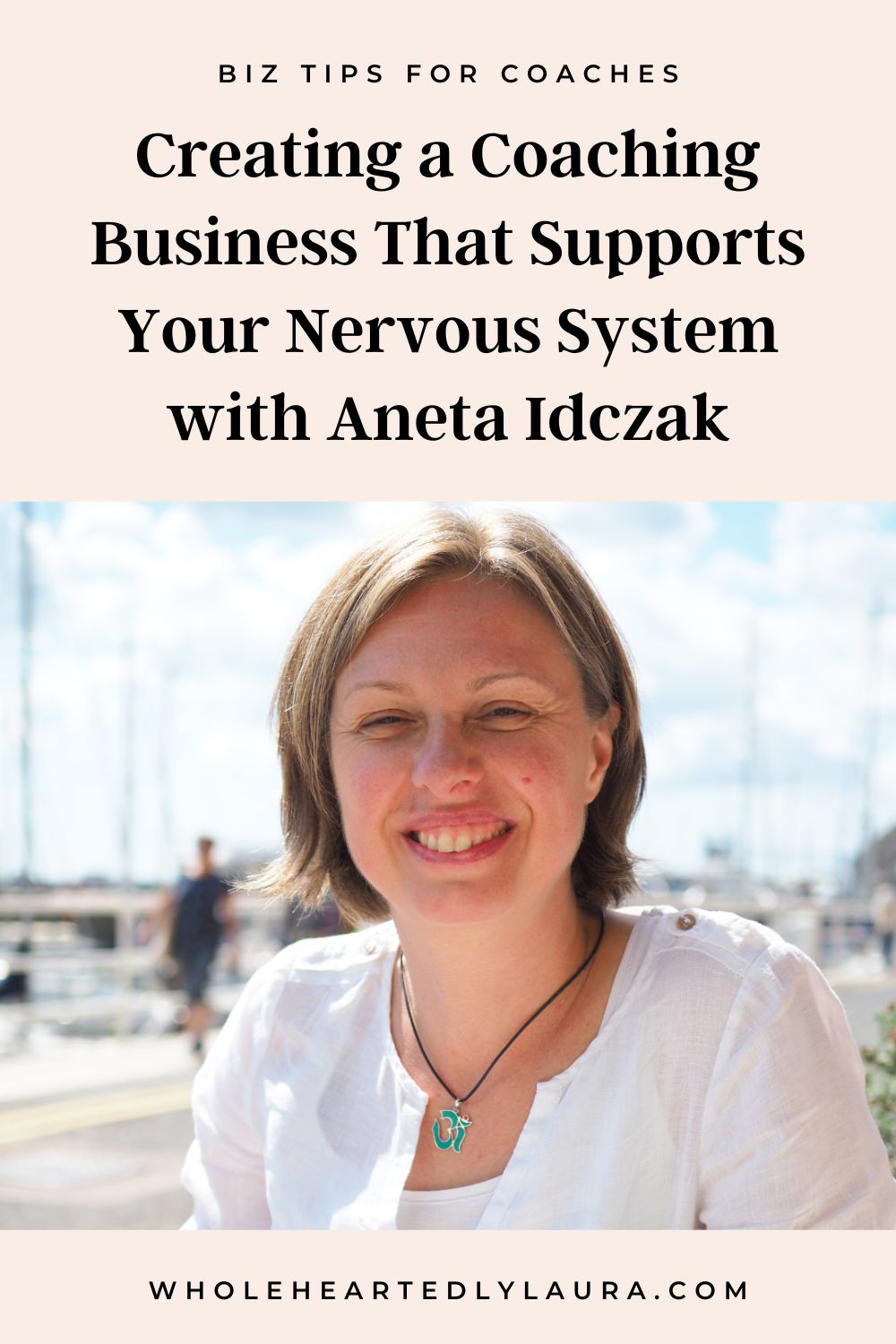
This week on The Wholehearted Business Show I’m talking all things nervous system regulation, feminine embodiment and trauma informed coaching with my wonderful client, Aneta Idczak.
Aneta Idczak is the founder of the Golden Mandala Somatic Coach Academy and the creator of the Trauma-Informed Somatic Teacher and Coach for Women© certification, the Soma-Psyche-Soul Coaching Method©, and the Embodied Business Mandala©. Her work empowers sensitive, visionary women to lead, coach, and grow in ways that are deeply embodied, values-led, and sustainable – anchored in nervous system regulation and soul-rooted confidence.
As a Trauma-informed Somatic Coach, Educator, Senior Yoga and Somatics Trainer, and Somatic Bodyworker, Aneta brings over 30 years of embodied practice and study. Her approach integrates trauma theory, somatic psychology, therapeutic and spiritual practices, neuroscience, years of social care work experience, and cyclical wisdom, which creates a deeply grounded, whole-person methodology for healing, Coaching, and Embodied Feminine Leadership.
Her Soma-Psyche-Soul Coaching Method© offers a unique integration of somatic awareness, identity and belief work, and soul and life connection – supporting women to embrace who they are, embody who they are becoming, and empower others through presence, care, and truth.
Rooted in a bio-psycho-social-spiritual lens and shaped by 25+ years of work with trauma in both community and private practice, Aneta’s work invites women to reclaim their voice, soften into their power, and lead from a place of inner alignment.
She is also the host of the podcast Through a Trauma-Informed Lens: Soma, Psyche and Soul, where she shares conversations and insights that challenge dominant coaching narratives and centres on wholeness, depth, and connection.
Tune in to learn:
- How to understand and honour your needs
- Why it’s so important to be trauma aware as a coach
- What feminine embodiment looks like
- How to support your nervous system in your coaching business
Watch or listen below, or check out the transcript of this episode.
Aneta’s links:
Listen to this episode on The Wholehearted Business Show Podcast: Listen on Apple Podcasts / Listen on Spotify
Transcript
[00:00:00]
Hi there. Welcome to the whole Heart of Business Show. This week on the show, I’m talking to the amazing Annetta Intract, and we’re talking all about themes and topics around embodying your feminine energy in your business, nervous system regulation, what it means to be a trauma-informed coach, and how to manage things.
If you are feeling overwhelmed and burnt out in your coaching business, plus a lot, lot more, let’s jump in.
Laura: Welcome Annetta to the whole Heart of Business Show. It’s so, so lovely to have you here. Would you like to start off just by telling us all about yourself and your business?
Aneta: Hello Laura. Thank you for inviting me to your podcast. It’s really lovely to be here. Okay. So I’m an
itra. I’m a, a trauma informed somatic teacher and coach. And I run training organization. I work with. Women. So women who want to work with other women in trauma informed [00:01:00] and somatic approach with focus on embodied, feminine embodiment, feminine leadership, and really embracing being a woman, a woman within today’s society with all the wonderful opportunities and all the challenges that we experience and really stepping into a different way of working. So. For me, it’s all about the inside out stuff. Like if we start with understanding ourselves, understanding our needs, and acknowledging and honoring those needs, then we can start making decisions from that more embodied present space in every area of our lives.
So when it comes down to our health, when it comes down to our relationships, and of course our work and business.
Laura: Yeah. Amazing. And I really, I mean, I love your work obviously, as you know, ’cause we, we, we, we work together [00:02:00] anyway. But I’d love to talk a bit more about feminine energy and feminine wholeness in, in our businesses because I think I.
When a lot of us get into business to begin with and, and start this process of going to business, there’s something very masculine about how we do it, and I think a lot of what we see in the world is a very masculine way of doing business. So I’d love to hear more from you about how we can embrace our embodied feminine illness basically in our businesses.
Like what, what that looks like, what we might need to think about, where. Where we often kind of start from that masculine place. I’d love to to talk a bit about that.
Aneta: Yeah, that’s such an interesting topic and we do live in a very masculine world and a lot of business stuff out there is very much ma about this masculine forward drive the hassle that is very much for more extroverted masculine approach.
And it’s taking me. You know, a very [00:03:00] long time, decades to arrive at a place where I allow myself to run my business and work and structure everything within my life and business that comes from more balanced view. So not just the feminine view, but actually arrive balance of the masculine and feminine because we need both of those.
I mean, my background is in social care where I worked for 16 years with. Addiction and mental health and child protection and it’s, you know, when I first left social care that was almost 10 years ago. And started working for myself. I brought all of that conditioning with me, this kind of working hard, expected to work outside of my agreed hours.
Laura: Yeah.
Aneta: Showing up. There is this really old joke about the social worker work looking worse than the client. You know, there, there is truth behind it and, but it’s not only [00:04:00] in social care, obviously, it’s in every area of our life. Yeah. And there is a lot of stuff on internet and YouTube about the guys and hustled and grind and, and what I find is like you can get away with a lot of that when you are younger.
Yes. One of the things that I work a lot with is the life seasons of Women’s Cycle. And so when you are younger. Many of us can get away with it. We can hustle, we can grind, we can crash and recover really quickly. You know, the typical burnout cycle of like push, push, push. And then we crash, we recover, and then we push again.
We start the cycle, the burnout cycle again. But actually as you start getting older, it’s much harder. So I found that where, you know, in my thirties and early forties I was able to work full-time run the yoga and wellness studio and coach people [00:05:00] evenings and weekends and study on top of this and do lots of courses and.
You know, that capacity to spin so many plates the same time greatly reduced and it started impacting my health. And so this is, this is really important for those of us who are, you know, a little bit older or getting older, coming to the end of our thirties, forties, and fifties. I’m very clear, you know, within myself that as a 52-year-old woman.
I cannot live how I used to live, you know, a decade or couple of decades ago. I have to adjust because the price that I will pay will be with my health. Whether it’s mental health, whether it’s physical health, whether it’s relationships all of that needs to be taken into consideration. And when we allow ourselves to acknowledge who we are, like.
This is why I love your work, for example. [00:06:00] Thank you. Yeah. Quite highly sensitive. Yeah. I’ve always been like that. You know, if I don’t take care of myself, I can’t sleep. My anxiety goes through the roof. I. You know, so I need to kind of balance it in a slightly different way and to understand that our life is cyclical and to really embrace and honor those cycles of like, now I’m working.
That’s great. I’m going all in. Okay. Now I need to rest. Yes.
Laura: Yeah.
Aneta: Rather than just keep pushing and keep forcing myself and, you know, show up on the social media at this. Yes.
Hitting the
Laura: goals and I’m doing it. And then your goals. Yeah. And I think it’s really interesting what you said there as well, and you know, you’ve highlighted something that I say in a lot of my clients is, is that. Most of us, I would say the vast majority of us are not co you know, leaving university or leaving school and becoming a [00:07:00] coach.
Most of us are coming, this is our second career for most of us, and the condition and that a lot of us carry exactly how you described from your social work background. We’re carrying a lot of that through, which a lot of that again tends to come because you know this running your own business, it, it has.
So much potential. I think that’s why a lot of people are attracted to it for the freedom for you being able, you being able to design your life the way that you want it to look. But we’re still kind of constrained by the, the condition that we’ve had from previous experiences. So what I love about your work as well is that, you know, through having that lens on things, that feminine energy, embodiment lens, I think it helps us come out of that.
Come out of that conditioning.
Aneta: Yeah, I mean, it’s so ingrained, isn’t it? It’s taken me, you know, almost 10 years to kind of shift it, even with doing this kind of work and training others and holding spaces and, yeah, I think there is something also in [00:08:00] here about. This the, the approach that women have got this much more feminine approach that is not just for women.
Men do that as well, but it’s, which is much more about collaboration, about supporting each other, about really being honest. I mean, what we are seeing in the world right now. Some of it is just ridiculous. You couldn’t write it as a, a comedy if you tried. And really, our responsibility, the way that I see it, is to be another voice in the conversation and say it in a different way and really point those things that this is, you know, this is unsustainable.
We can’t live like this and we might not have the power. All of us to go to the government and do it in that way, but on the grassroots level. Every single one of us that does things in a slightly different way and [00:09:00] shows that it’s possible to do it in a sustainable way, gives permission to all the other women to actually at least try it out, to actually know that that is a possibility.
Yeah. That we don’t all have to hassle and grind and you know.
Laura: Yeah, all of that. All of the, yeah, all of the broad marketers and things that you see
Aneta: and I think be always on, you know, it’s like, and that’s, that’s why I love your work, for example as well. It’s like this, we can create discoverability, we can work with outside of the noisiness of the social media, and that’s certainly something that is.
Much more attuned to the nervous system regulation and sustainability.
Laura: Yes, absolutely. And I, this nicely brings us on to chat a little bit about trauma informed work and being a trauma informed coach. I know that’s a big part of what you teach as well is around having that that trauma informed like [00:10:00] approach to your work basically.
I’d love to find out more about that, kind of why is that so important for coaches to be aware of that and how. Can they start on that journey of being more trauma informed in their work?
Aneta: Yeah, that’s a really great question. For me, that’s the essence of everything. When we understand, I. Our reactions, our responses through the lens of the nervous system and you know, our biology and our past history.
We can support others in a much better way. So. I can share with you a story, for example of, in my own experience of how it played out within the context of business coaching. Yeah. So I signed up to work with somebody a business coach, who I thought, right, this person is so different from me, so on it.
In a very masculine way that that was quite a few years ago and it didn’t click still at that time. That, [00:11:00] that’s what I need. ’cause I am not like that person. And it would be so great to be supported by somebody like that. And I signed up with them and it was quite a bit of money. But what happened was, not that I.
Thrived and I stepped in Instead. What happened was I went into a freeze response. It was too much for my system.
Laura: Yeah.
Aneta: I just, I just couldn’t, there were, there were some beliefs and thoughts around visibility and reaching out to people that jumped from where I was to where I was trying to jump with that coach was way too much, and so rather than.
Chunk it down and understand what was going on. I reacted, and the other coach, the coach wasn’t you know, didn’t have that understanding at the time, and so I paid lots of money. I went into freeze. I procrastinated, I was hiding. [00:12:00] I felt ashamed because I thought, well, there is something wrong with me, obviously, because I’m not doing it.
I’m saying I wanna do it. I. I’m not doing it. And actually I just wasted that time and that money. Yeah. And walked away with Yes. Learning that, that that doesn’t work for me.
Laura: Yes.
Aneta: Whereas. If you have got understanding around the nervous system, you know when you come from that understanding, you can spot it.
One of the things that I teach is how to read somebody’s body language and their presentation and how they engage with you to understand what’s going on for them on a mind level and the the state level. And so, you know, when I work with somebody, I can see they just go into. To freeze, they might say, no, no, no, I’m okay, but I can, I can see, you know, I can read their body language and so then gently I can name it for them.
Yes, and I can bring them back into [00:13:00] engagement and we can chunk down and see, you know, what’s, what’s achievable for that person? How can we work? Differently. I can support them in a much better way. One of the things that I say in the training is you can work with your client, whatever the context, business healing, coaching relationships, I.
You can work with your client and move forward only as fast as the nervous system allows you to. Yeah, that’s
Laura: it. Yes, I’ve been saying that for so long as well, but your business will only go line with what your nervous system can hold and it’s, you know, again, I think this is why we, we get out so well ’cause we’ve got the same thing.
But yeah, it’s, it’s so important, isn’t it? And I think a lot of. It is sad that there’s that potential for some coaches to railroad the clients a little bit and not actually be able to hold space for them for where they are and and create that journey for them. It’s difficult, isn’t it?
Aneta: I mean, I understand the approach of like bringing [00:14:00] somebody to the edge and push them so they fly.
And sometimes that approach, which is much more masculine, it works, but actually so often it doesn’t. For those of us who are much more sensitive, who come from this hard open space to connect with others who have got a lot of empathy, who might have experienced trauma or traumatic events in the past, yeah, this approach just doesn’t work.
And then, you know, our clients do what I’ve done, like internalize it and say. Well, you know, there is something wrong with me because obviously this coach is very successful with other people, but it doesn’t work with me. So it works for others. It doesn’t work for me. Something is wrong with me. And so, you know, the, there can be a lot of shame.
That can be a lot of. Broken dreams. Yeah. And unfulfilled dreams. Yeah. And that’s very sad. So knowing that there is a different way, much [00:15:00] kinder, much more compassionate way that comes from presence that is about your own personal journey rather than some kind of goals that are. Outside like a hundred K or 200 K, that actually would mean that would require you to work in a way that you don’t actually wanna work.
You don’t like working in that way. Yes. So why striving for something like that? And I think many of us can get caught up with that and an effective coach will say, well, you know. Do you realize that this is what you would have to do in order to, to bring that? And is that what you want to do? Yeah. So there’s a lot of scope for collaboration with your client, for reducing the power dynamics, for really coming from that empathy and heart-centered way to support somebody to, on their journey, to create the life and the business that they truly love.
Yeah. [00:16:00]
Laura: No, a hundred percent. And it’s, it’s just such a, I think it’s a part of business especially that is just really forgotten in terms of, you know, and again, I’ve certainly signed up for programs that have not been the right fit. And there is a part of starting to understand yourself. And again, this is why I talk a lot about being heart centered and highly sensitive because what.
Works for other people who are not necessarily that way, will not work for us. It would, it will just kind of cause that total freeze response. You know, and again, trying to work in that more masculine way sometimes leads to, you know, feeling burnt out and overwhelmed and, you know, a lot of that kind of stuff.
Which is again, another thing to, to talk a bit about in terms of that burnout and overwhelm and how often coaches can find themselves in that space, even when, you know, it’s, it’s that whole thing, isn’t it? A lot of us. Put the pressure on ourselves to feel like we should have everything figured out because we’re a coach and because we coach about whatever topics that we coach [00:17:00] about.
But that’s not always the case, is it? And, and often we need some of our own medicine. But when it comes to kind of overwhelming burnout, what do you see is the role of the nervous system and that feminine embodiment that can support us if we find that we’re starting to dip into that burnout and overwhelm kind of space as coaches?
Aneta: Yeah, really good question. I, I think a lot of it is about the foundations. Like we you know, so often we want the advanced stuff. Yeah. We want I. More through and, you know, reach higher. But actually a lot of it is about foundational stuff. So certainly in the training and the clients, other practitioners and women that I work with and the clients it’s about really establishing those foundations.
And the foundations are for me about really understanding how I am [00:18:00] first. Then asking myself, now that I know how I am, what are my needs? Like what do I need in the context of knowing how I am? And then the last step is about meeting those needs in an empowered way. And so, so often we, I. Don’t go through all those three steps.
We either don’t know how we are and we just trying, lots of different things coming from different advice out there that it doesn’t really match how, how we are in this moment, or we know how we are. And we know what we need, but we don’t make decisions from that empowered space to meet our needs because we believe we can’t, or it’s too much, or we are not entitled to, we are not worthy.
You know, there can be all sorts of different stuff going on, and so, or we know how we are, but we completely drown. In it and kind of feel completely [00:19:00] helpless within that because we don’t know how to actually meet our needs. So there is the whole of that cycle that allows us to really get to know ourselves, to trust our inner responses, to honor our inner responses, to honor our needs, with the understanding that every single thing that you do.
Is built on your ability to understand, meet, and honor your needs in an empowered way. Yeah. Every single thing, like so many women and you know, I’m, I’m guilty of that. Two, and I have been over the years, you know, we put ourselves at the bottom of the list. You know, we, we don’t prioritize really our needs.
And I think that comes from really misunderstanding, not understanding that everything is built on that. Because if you don’t meet your needs, if you don’t. Take care of yourself. You are gonna crush, you’re gonna hit burnout, [00:20:00] and then nothing is gonna get done. Yeah, exactly. Absolute, exactly. Everybody who relies on you will not be able to get support from you.
This is why we need to take care of ourselves, first of all, and this is a big thing that I see when I work with women. We don’t get that. Like we understand it on a mind level, like Yes, yes, I understand. I, of course that makes sense. And then there is this cognitive dissonance, like we act in a different way.
So one of the things that I often ask women is if you were observing your friend behaving the way that you are behaving. And then saying what you are saying, is there alignment or is there that cognitive dissonance? Like you say one thing and you are observed. Behaviors as something completely different.
Laura: Yeah.
Aneta: Those two need to [00:21:00] match, like, and one of the things is if you say that you are honoring your needs and you’re taking care of yourself, that needs to happen every single day. Not on the days when you are already tired, you are already struggling. Then you bring your tools and practices and you start doing stuff.
It actually has got to be a way of life. It has to become an embodied way of being. Yeah. It has to come from, well, you know, when I get up, I just check in with myself. How am I right now? Okay. Today I am a little bit more tired.
Laura: Yeah.
Aneta: Okay, so what do I need and how, you know, maybe I have a really busy day, so how can I pace myself?
Laura: Yes.
Aneta: Today, you know, maybe that it, and it’s back, back to basics. Normally a bit of water.
Laura: Yes. A bit of,
Aneta: a bit of [00:22:00] movement, a bit of downtime. You know, it’s very, very simple. But we overcomplicate it so often.
Laura: Yeah. Yeah. And sometimes that over complication of those practices can lead to kind of even more feelings of overwhelm, can’t it?
So it’s a, it’s a good reminder that it’s yeah, it can be simpler and just start with that. Check it simpler. Yeah.
Aneta: It really has got to be simpler because if it’s gonna be sustainable, yes, of course. It has gotta be simple enough for you to kind of follow up and keep coming back to it.
Laura: Yeah, no, 100%. And it is like, you know, again, all this, all of this ties in so much I think with how, you know, I, I’ll often call this walk and you talk, but it is that embodiment.
It’s, it’s that, it’s where your, what you think and what you see match your actions. And I think as a coach, that is so powerful because again, no one’s perfect. Kind of going back to what we were chatting about a bit, a bit before. No coach is [00:23:00] exactly perfect in everything that they do, even in the thing that they support people around.
But what we can do really well is we can, you know, do that process of walking our talk, of embodying what it is that we say and have our actions match that. And I think that’s something that all of us can do, you know, really, really well. And, and that’s often the thing that I kind of hold myself to is a bit like when I’m not doing that, it’s like, okay, you, we need to look at what is going on there, Laura, because that’s.
You know that, that that’s not you. And it, it’s a really helpful process I think understanding that. Yeah. So yeah, so if I can say, if I can
Aneta: say, it’s like, I, I always say it as well, it’s like walking your talk. Yeah. And, and I love what you just said ’cause it is not about being perfect. Yeah. It is not about being sorted.
It is not always being positive. Yes it is. Not always not being angry. Yeah. You know, there can be so many different things that we think it is, but it, it is about really [00:24:00] showing up for yourself and not abandoning yourself in the process. And really taking care of yourself. Understanding that there is a real huge correlation between what you say and what you do.
And if they don’t match. As you said, like you need to, you need to find out why. What’s going on in here.
Laura: It’s and just that simple active self-inquiry I think is really powerful. ’cause often I’ve gotten some of the most profound. Wake up calls I think I’ve had is, is by doing that. It’s like, this is what I know, that I believe in.
This is what I teach. Like this is the thing. So why is that not happening? Like, like what is going on there? And, and that like, I think that’s such a great foundation for a lot of things. And again, I think in terms of your nervous system being able to, to hold the next level of growth, that’s, to me, that’s really connected with that in a lot of ways I think.
Aneta: Yeah, definitely there is, you know, our capacity, we [00:25:00] can work with our capacity.
Laura: Yeah. There is
Aneta: a model of window of tolerance.
Laura: Yes. You
Aneta: know, that talks about, you know, how can we increase the capacity and normally we increase it. The way that I see it, normally we increase it with baby steps. Yeah. And every time you abandon yourself, you erode a little bit of your self trust.
Yeah. And you reduce your capacity and every time you acknowledge with loving kindness your needs and what’s going on for you, the support that you need your own rhythm. You are on inner knowing every time you acknowledge it and you trust it, and then you act on it with compassion, with presence, you, you grow your capacity and you grow your inner self-trust.
Yes. So, you know, we all know people who walk into the room and it seems like, oh God, they so grounded, they so present and that that is a very simple practice that can [00:26:00] lead you. To that sense of embodiment. And one of the things that I wanted to say in here is, and I say that in my training
Laura: mm-hmm.
Aneta: Embodiment is like we talk about embodiment as something we go towards, but what we really mean about this is a special kind of embodiment. Which we talk about being more present, mean, con more connected, mean more compassionate, curious walking our talk. But actually we embody, we are always embodying something.
Yes. And the question in here is what do you embody and do you want to embody what you’re embodying? Because sometimes we can embody. Depression. We can embody hopelessness, we can embody anxiety or rage. You know, these are also states of embodiment. Yeah. The state of survival or thriving. You know, we always embody something, but when we choose to do it [00:27:00] in a conscious, mindful, present way, that’s when we start making decisions from a different place.
And that sense of embodiment, you know, it’s like, it’s ultimately, it’s the self-concept and the self-identity, isn’t it? Yes, yes. Who do I want to be, or who do I need to become if I want to have this kind of business? Yes. Or this kind of life, or this kind of relationship, or this kind of health, because things don’t happen by themselves.
Laura: Yeah.
Aneta: We have to show up and make those things happen.
Laura: Yes. We were just, funny enough, we, we, in my group program, wholehearted business, we had a mindset call last week and we were talking about self-identity and self-concept and, and then one of the one of the members of the group she shared on the. Er chat that we have.
And she said, you know, today, it was the first time I actually said to someone before anything else, oh, I’m a health coach. And it was, you know, just like that little, like that little thing. So how important that is. And I love that this is all [00:28:00] such a, it, it is just such a big conversation about all these topics is, is really fascinating and I hope everyone who’s been listening and watching has found this useful because I think this, having this awareness and having these approaches in your business are so, so valuable.
You know, these days when it’s very easy to be taken out of your own alignment and you know, again, and to be sucked into a really masculine way of work and that they ultimately can be quite damaging if it’s not the right thing for you. So thank you so much for sharing all of that, Annette, that’s been brilliant.
So where can people find out more about you and all of your amazing training and everything? Let us know. Well,
Aneta: thank you so much. First of all, I really enjoyed the conversation. And if people are interested, they can find me on Facebook or Instagram under an Ira, somatic coach and I on my website.
Anta et track.com. Yes, all the links. It’s
Laura: difficult to spell. We’ll have all the link, all the links will be in the description, all the, all of the notes. And I’ll tag you on YouTube [00:29:00] ’cause you’ve got a fabulous YouTube channel as well. So I make sure that you tagged on that. And then you’ve got a fantastic free masterclass.
That’s right. We’re going to link to as well. So do you like, tell us a little bit about that masterclass ’cause it sounds amazing.
Aneta: Yeah. So I ran in the masterclass a while ago called Journey to Embodied Feminine Fullness. And it’s about self-identity and embodiment, feminine embodiment. And that introduces you to the work that I do within the training certification called Trauma Informed Sematic Teacher and Coach for Women.
But it’s a really lovely taste there. The, it’s the recco, the recording is of the live class, which was really great with the interaction with women who are present there. And I hope that you will find it useful on your own journey. Yeah. Towards feminine embodiment and leadership.
Laura: Amazing. Oh, thank you so much, Annette.
Thank you.
Aneta: Thank you,
[00:30:00]
↓Pin for later ↓
0 Comments